HandMimic
Learning Dexterous Manipulations from Videos
Anonymous Authors
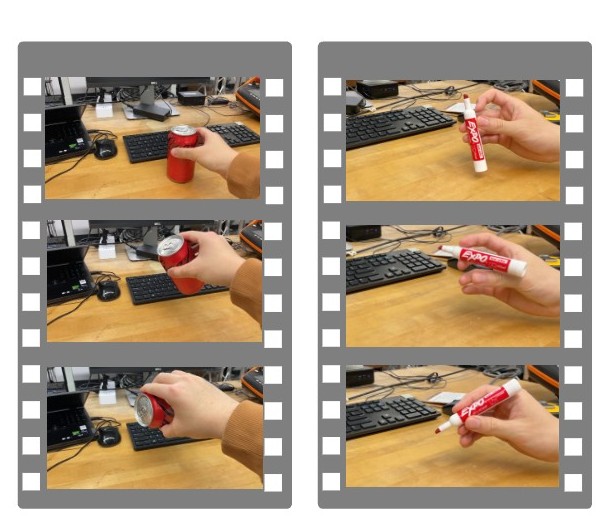
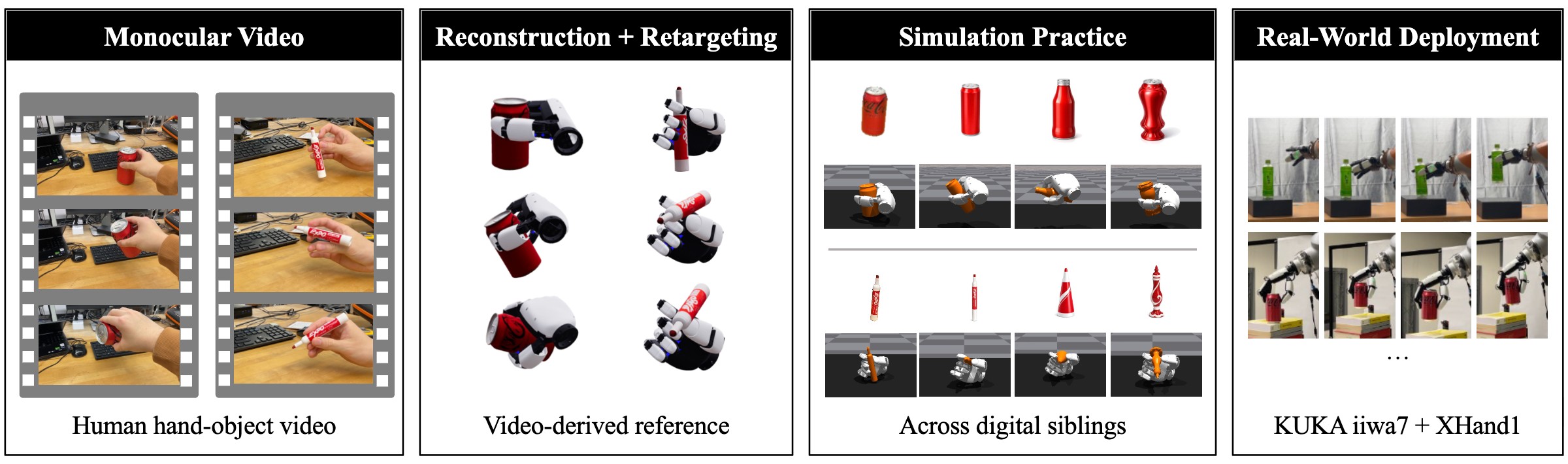
TL;DR: HandMimic learns dexterous manipulation from monocular human videos. It treats the reconstructed hand–object motion as an imperfect reference and practices it with RL in simulation, across digital siblings of the object.
Abstract
While humans naturally learn dexterous manipulation by watching others and practicing, robotic teleoperation of dexterous hands remains prohibitively expensive and non-trivial. We introduce HandMimic, a framework for learning dexterous manipulation policies directly from real-world monocular videos. We first reconstruct and align the observed hand-object interaction in simulation, while treating the resulting motion as an imperfect reference rather than a physically valid robot demonstration. We then practice in simulation using reinforcement learning to recover physically feasible behaviors from the reconstructed reference. To reduce dependence on a single reconstructed object, we further train across digital siblings with varying geometry and scale. Quantitative experiments show that policies learned from reconstructed references approach those trained from ground-truth references, while digital-sibling training improves generalization to unseen geometry and scale variations. We further validate the resulting motions on a real dexterous robot. Together, these results support using reconstructed human interactions as references for physical practice across varying object geometries.
Method
Even strong monocular reconstruction leaves errors in object pose, metric scale, occluded fingers and unseen geometry. These errors look small in the image but change the contacts that manipulation depends on, and a human hand motion does not directly define a robot hand motion. HandMimic therefore uses the reconstructed and retargeted motion only as a reference, and resolves physical feasibility through policy learning in simulation.
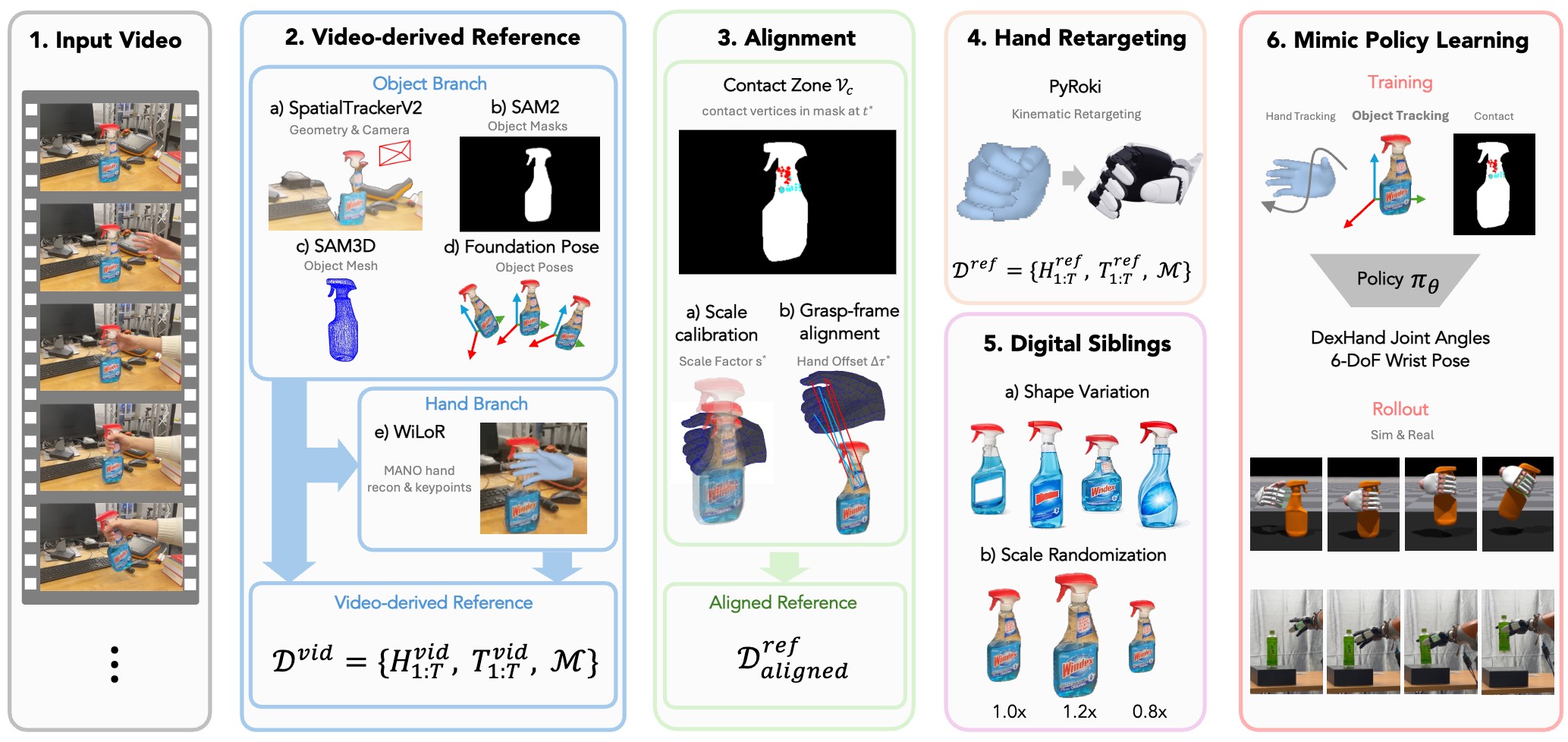
We segment the object with SAM2 and reconstruct its mesh with SAM3D, using camera parameters from SpatialTrackerV2. FoundationPose tracks the object’s 6-DoF pose and WiLoR recovers the MANO hand. Because the hand and object are reconstructed separately, we calibrate scale from hand–object contact and align translation in the grasp frame, which places both in one metric, table-aligned frame.
Reconstruction and alignment for two in-the-wild videos. The object and hand overlays follow the video closely.
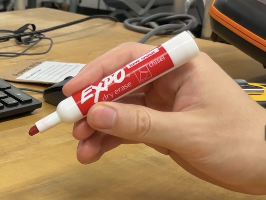
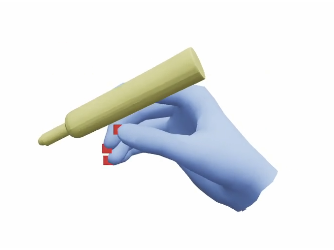
Decent, but not perfect. Zoom in on the grasp, though, and the reconstructed fingertips do not touch the object where the real hand does. Even small gaps like these change the contacts that manipulation depends on, so the reconstruction cannot simply be replayed on a robot.
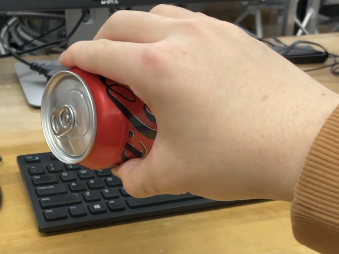
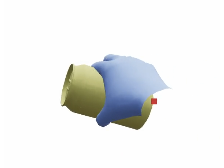
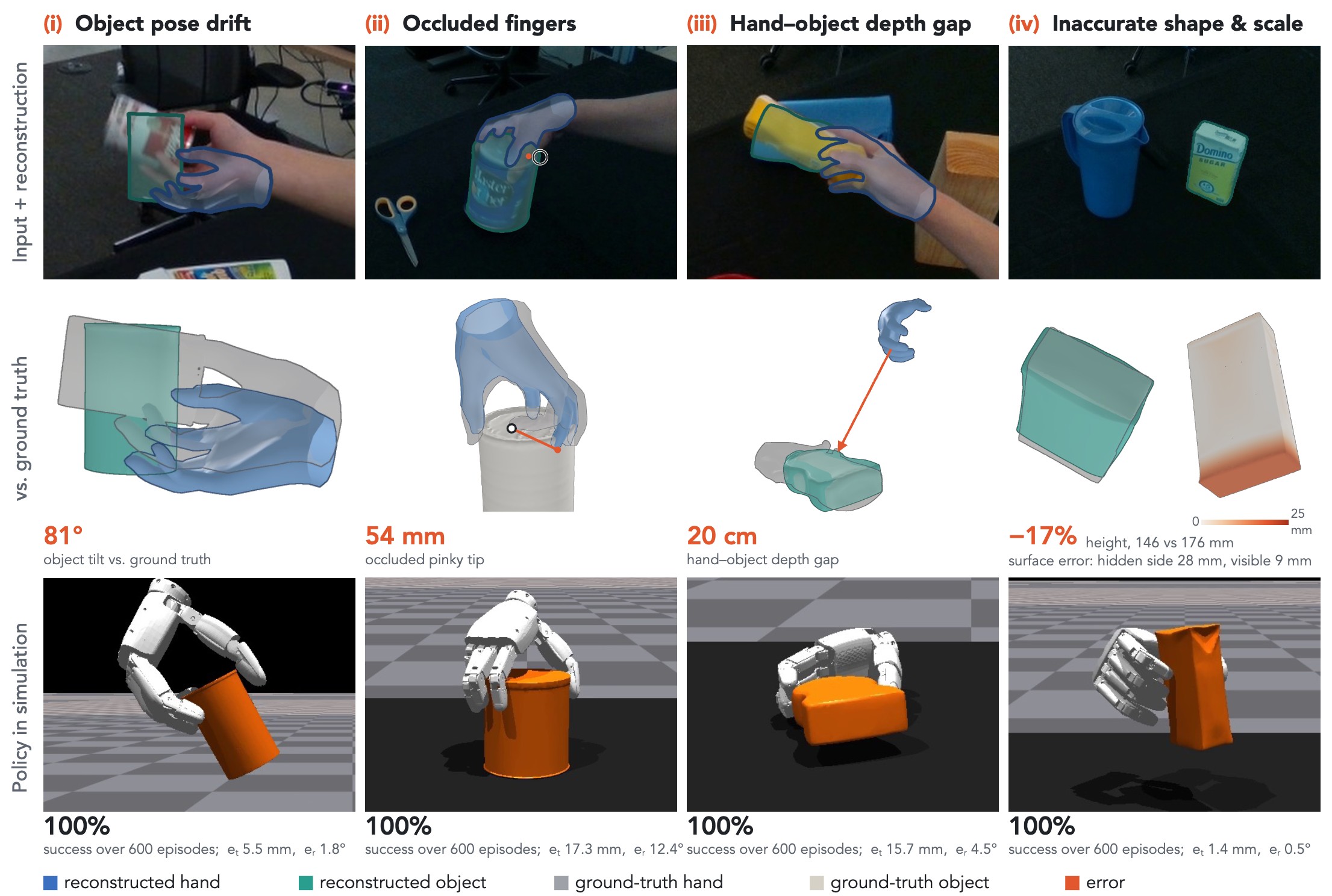
The errors fall into four recurring types. Object pose drift, occluded fingers, a hand–object depth gap, and inaccurate shape and scale. The reconstruction pipeline does not remove them. Instead, HandMimic treats the result as an imperfect reference and lets practice in simulation recover behaviors that reproduce the demonstrated object motion despite them.
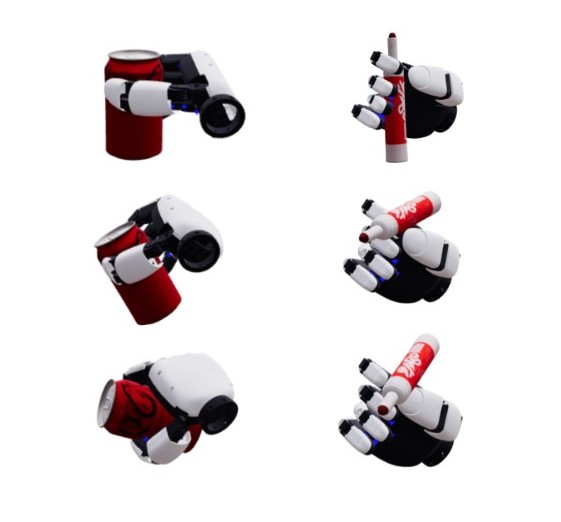
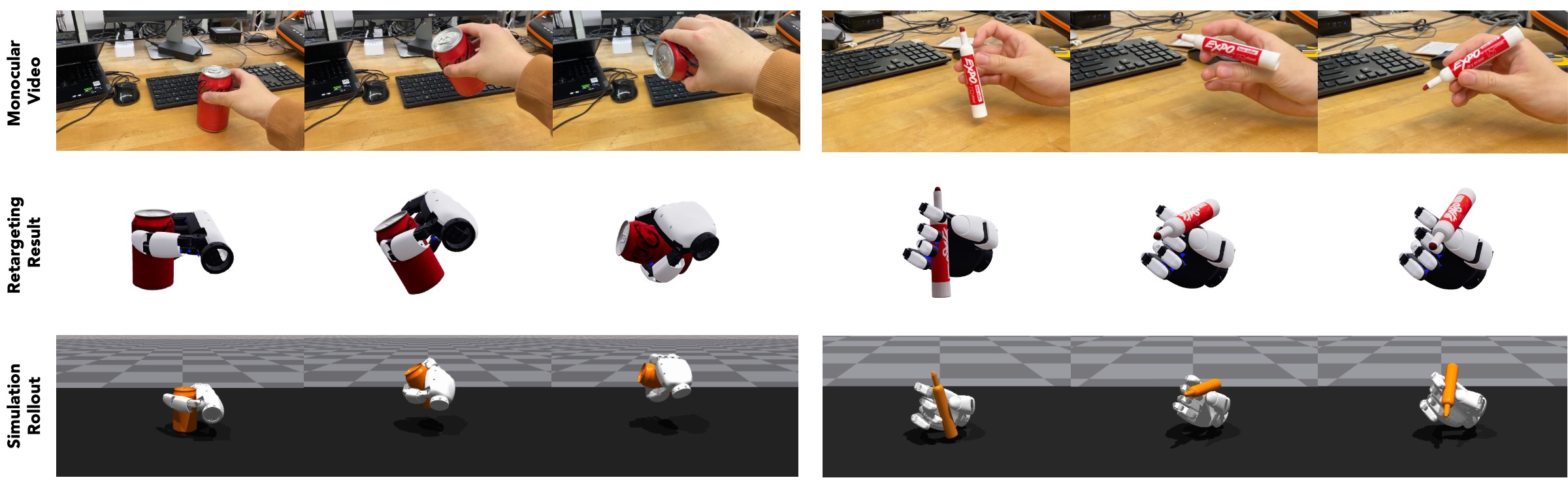
PyRoki retargets the aligned MANO trajectory to the dexterous hand. It matches hand geometry while preserving grasp-frame contacts and temporal smoothness. The retargeted motion does not need to be physically executable; it only provides kinematic and object-motion targets for policy learning.
The aligned MANO motion is retargeted to the XHand1 while keeping the object trajectory from the video.
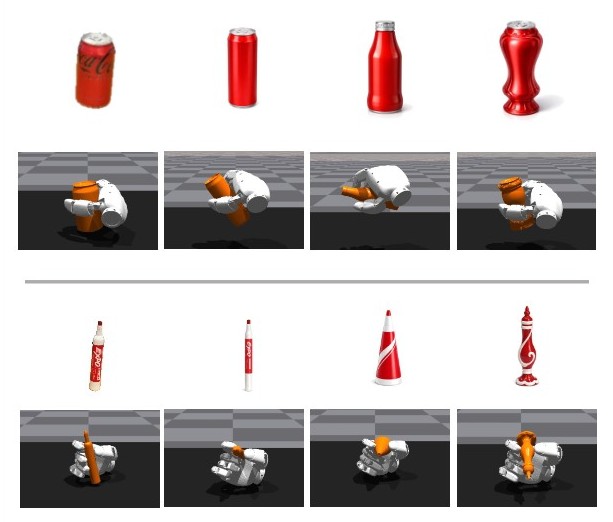
A policy trained on one reconstructed mesh can overfit to its errors. We build a set of digital siblings, the reconstruction plus K generated shape variants, sample one per episode and randomize its scale, so the same reference is practiced across geometries.
so ∼ 𝒰(0.8, 1.2)
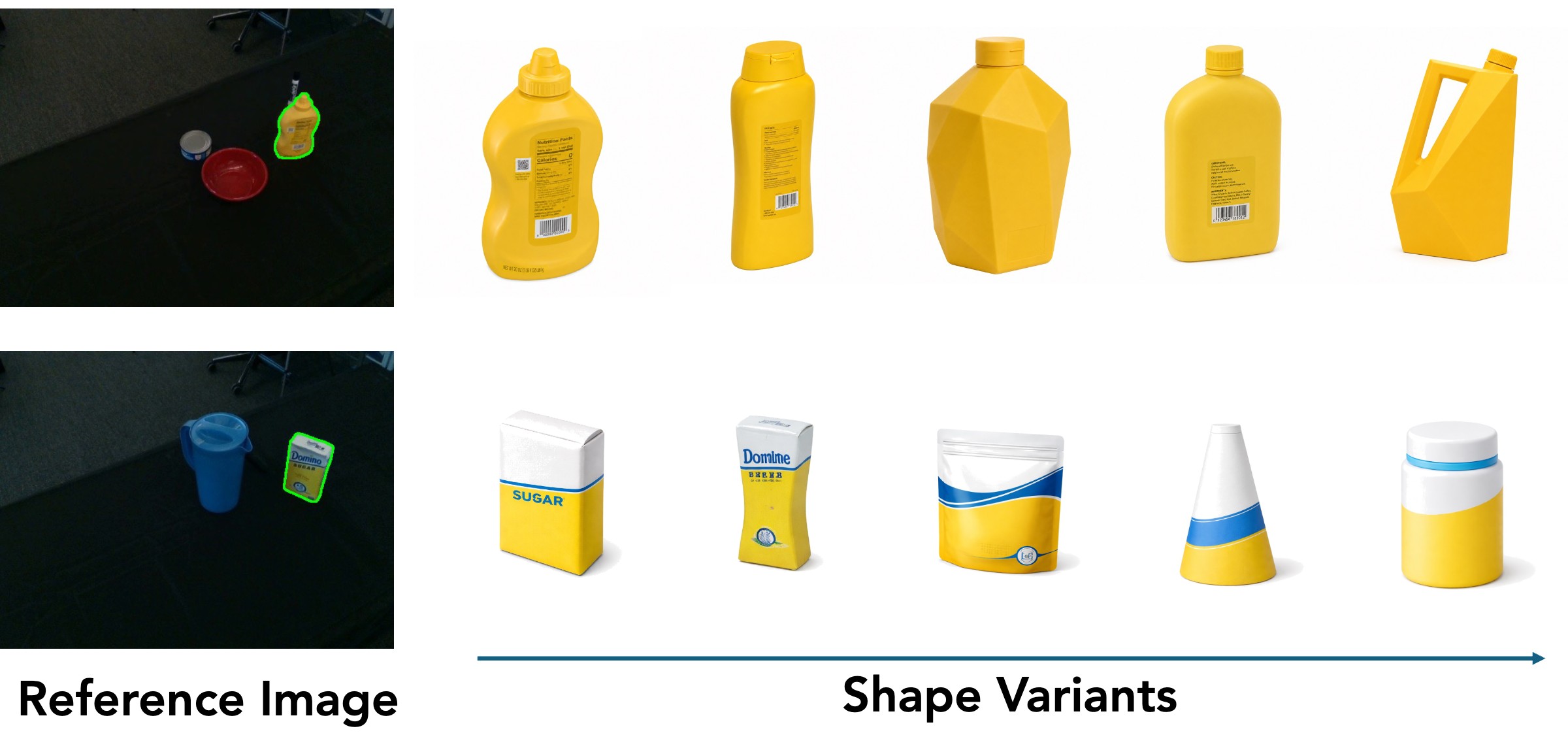
The same retargeted hand and object trajectory, replayed on the reconstructed object and on three generated siblings.
Following ManipTrans, a closed-loop RL policy tracks the reference in simulation. The demonstrated object trajectory is the main objective and the retargeted hand is only a kinematic target, so the object term is weighted higher. Hand-tracking early termination is removed after grasp, which lets the policy find feasible contacts instead of copying the retargeted hand.
rt = whandrhand + wobjrobj + wcontactrcontact + rreg, wobj > whand
Policy rollouts in simulation on four digital siblings per video, slowed down 3×.
Results
We evaluate on 28 DexYCB sequences with 8 YCB objects and on 6 in-the-wild iPhone videos. A rollout is successful when the object rotation error ER is below 30° and the translation error ET is below 60 mm. Each DexYCB result is computed over 600 rollouts.
HandMimic gives the best hand–object alignment, posed object geometry and temporal smoothness. Do as I Do has slightly lower PA-MPJPE, which measures local hand articulation only and does not reflect the hand–object interaction.
| Method | PA-MPJPE ↓mm | MRPEobj ↓mm | F5posed ↑% | F10posed ↑% | CDposed ↓mm | Jerk ↓mm/frame³ |
|---|---|---|---|---|---|---|
| DexImit | 5.90 / 5.73 | 126.37 / 75.99 | 15.63 / 12.07 | 28.64 / 24.21 | 180.99 / 21.82 | 6.53 / 5.53 |
| Do as I Do | 3.60 / 3.44 | 81.61 / 69.68 | 14.28 / 15.92 | 28.67 / 33.26 | 25.41 / 20.57 | 3.84 / 3.70 |
| HandMimic (ours) | 3.87 / 3.80 | 60.57 / 39.85 | 22.02 / 22.09 | 42.81 / 45.23 | 16.28 / 13.57 | 0.63 / 0.61 |
Table 1. Hand–object reconstruction on DexYCB, mean / median over 28 sequences. Bold marks the best mean.
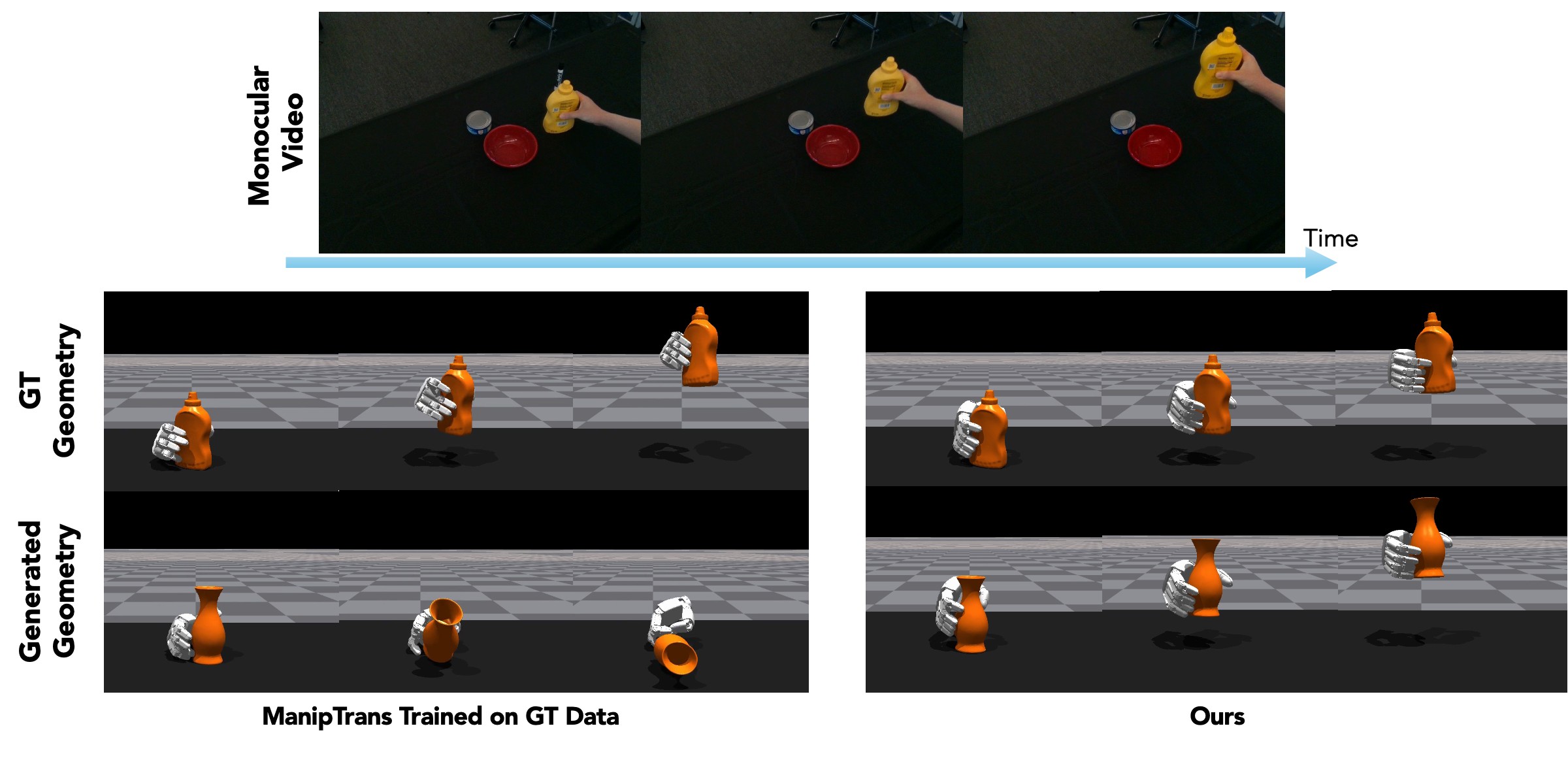
With ground-truth demonstrations, HandMimic is comparable to ManipTrans (71.4% vs. 75.7% success). With reconstructed demonstrations, HandMimic keeps 67.8% while ManipTrans drops to 6.0%. When the reconstructed mesh is used as well, HandMimic reaches 85.7% on DexYCB and 83.3% on in-the-wild videos, against 35.4% and 38.5% for ManipTrans. Compared with Do as I Do, it succeeds on 24/28 sequences against 0/28 under our criterion, and 27/28 against 17/28 under theirs.
| Method | Object mesh | DexYCB | In-the-wild | ||
|---|---|---|---|---|---|
| ER (deg) ↓ | ET (mm) ↓ | SR (%) ↑ | SR (%) ↑ | ||
| Ground-truth demonstration | |||||
| ManipTrans | GT | 14.0 | 10.3 | 75.7 | – |
| HandMimic (ours) | GT | 7.6 | 16.0 | 71.4 | – |
| Reconstructed demonstration | |||||
| ManipTrans | GT | 30.9 | 44.7 | 6.0 | – |
| ManipTrans | Reconstructed | 25.3 | 34.8 | 35.4 | 38.5 |
| HandMimic (ours) | GT | 10.5 | 13.6 | 67.8 | – |
| HandMimic (ours) | Reconstructed | 4.6 | 10.1 | 85.7 | 83.3 |
Table 2. Rotation error, translation error and success rate for different demonstration sources and object meshes. Only success rate is available for in-the-wild videos.
Rollouts of ManipTrans and HandMimic from the same reconstructed DexYCB reference, once with the ground-truth CAD model and once with the generated geometry.
We test on held-out real scans from YCB, Google Scanned Objects and OmniObject3D, grouped by normalized Chamfer distance d to the reconstructed mesh. Training on a single reconstructed mesh overfits to it. Scale randomization helps, and training across digital siblings transfers best to new shapes. Retrieved and generated siblings perform similarly, so most of the gain comes from practicing on several geometries rather than from how the siblings are obtained.
| Training geometry | DexYCB | In-the-wild | |||||
|---|---|---|---|---|---|---|---|
| GT scan | Recon. | Closed ≤ 2% | Mediumd ≤ 3.5% | Fard ≤ 10% | Recon. | Held-out | |
| Single reconstructed mesh | 18.0 | 69.3 | 9.8 | 6.4 | 3.5 | 83.1 | 0.0 |
| Scale randomization | 62.1 | 85.6 | 72.5 | 57.3 | 21.6 | 83.3 | 30.7 |
| Retrieved siblings + scale | 67.9 | 85.7 | 81.5 | 72.3 | 40.6 | 83.3 | 36.9 |
| Generated siblings + scale (ours) | 67.8 | 85.7 | 80.3 | 70.2 | 36.6 | 83.3 | 43.3 |
Table 3. Success rate (%) for different training geometries. Both sibling variants use 12 siblings per demonstration with the same scale randomization and training budget.
The six in-the-wild iPhone videos, each a single monocular RGB clip.
Real-World Deployment
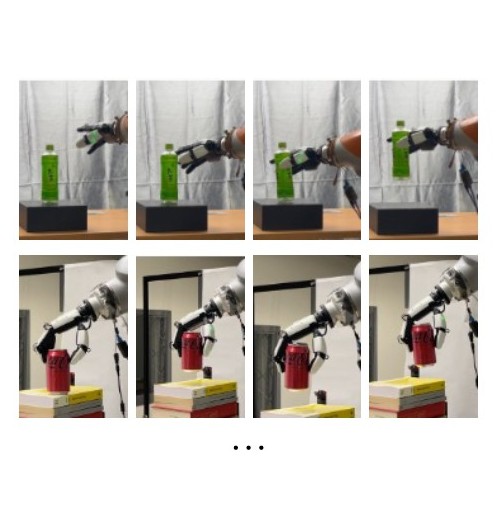
We replay the learned motions open-loop on a KUKA iiwa 7 arm with an XHand1 hand. SAM2 segments the target object and FoundationPose estimates its 6-DoF pose from an RGB-D view and the reconstructed mesh, which anchors the simulation frame to the real scene. The simulated rollout is transformed into that frame: the wrist trajectory becomes KUKA joint targets through inverse kinematics, and the hand trajectory maps to XHand1 joint targets.
Limitations
HandMimic assumes rigid objects with consistent geometry over time, so articulated and deformable objects are not handled directly. The reconstruction pipeline relies on segmentation, pose tracking and hand estimation, which can fail under heavy occlusion, fast motion, symmetry or difficult appearance. These errors can propagate to retargeting and policy learning.
Citation
References
- Nikhila Ravi, Valentin Gabeur, Yuan-Ting Hu, Ronghang Hu, Chaitanya Ryali, Tengyu Ma, Haitham Khedr, Roman Rädle, Chloe Rolland, Laura Gustafson, et al. SAM 2: Segment Anything in Images and Videos. ICLR 2025.
- Xingyu Chen, Fu-Jen Chu, Pierre Gleize, Kevin J. Liang, Alexander Sax, Hao Tang, Weiyao Wang, Michelle Guo, Thibaut Hardin, Xiang Li, et al. SAM 3D: 3Dfy Anything in Images. CVPR 2026.
- Yuxi Xiao, Jianyuan Wang, Nan Xue, Nikita Karaev, Yuri Makarov, Bingyi Kang, Xing Zhu, Hujun Bao, Yujun Shen, Xiaowei Zhou. SpatialTrackerV2: Advancing 3D Point Tracking with Explicit Camera Motion. ICCV 2025.
- Bowen Wen, Wei Yang, Jan Kautz, Stan Birchfield. FoundationPose: Unified 6D Pose Estimation and Tracking of Novel Objects. CVPR 2024.
- Rolandos Alexandros Potamias, Jinglei Zhang, Jiankang Deng, Stefanos Zafeiriou. WiLoR: End-to-End 3D Hand Localization and Reconstruction In-the-Wild. CVPR 2025.
- Javier Romero, Dimitrios Tzionas, Michael J. Black. Embodied Hands: Modeling and Capturing Hands and Bodies Together. ACM Transactions on Graphics (SIGGRAPH Asia) 2017.
- Chung Min Kim, Brent Yi, Hongsuk Choi, Yi Ma, Ken Goldberg, Angjoo Kanazawa. PyRoki: A Modular Toolkit for Robot Kinematic Optimization. IROS 2025.
- Kailin Li, Puhao Li, Tengyu Liu, Yuyang Li, Siyuan Huang. ManipTrans: Efficient Dexterous Bimanual Manipulation Transfer via Residual Learning. CVPR 2025.
- Yu-Wei Chao, Wei Yang, Yu Xiang, Pavlo Molchanov, Ankur Handa, Jonathan Tremblay, Yashraj S. Narang, Karl Van Wyk, Umar Iqbal, Stan Birchfield, et al. DexYCB: A Benchmark for Capturing Hand Grasping of Objects. CVPR 2021.
- Berk Calli, Arjun Singh, Aaron Walsman, Siddhartha Srinivasa, Pieter Abbeel, Aaron Dollar. The YCB Object and Model Set: Towards Common Benchmarks for Manipulation Research. ICAR 2015.
- Juncheng Mu, Sizhe Yang, Yiming Bao, Hojin Bae, Tianming Wei, Linning Xu. DexImit: Learning Bimanual Dexterous Manipulation from Monocular Human Videos. arXiv:2602.10105, 2026.
- Bhawna Paliwal, Haritheja Etukuru, William Liang, Pieter Abbeel, Nur Muhammad Mahi Shafiullah, Jitendra Malik. Do As I Do: Dexterous Manipulation Data from Everyday Human Videos. arXiv:2606.19333, 2026.
- Laura Downs, Anthony Francis, Nate Koenig, Brandon Kinman, Ryan Hickman, Krista Reymann, Thomas B. McHugh, Vincent Vanhoucke. Google Scanned Objects: A High-Quality Dataset of 3D Scanned Household Items. ICRA 2022.
- Tong Wu, Jiarui Zhang, Xiao Fu, Yuxin Wang, Jiawei Ren, Liang Pan, Wayne Wu, Lei Yang, Jiaqi Wang, Chen Qian, et al. OmniObject3D: Large-Vocabulary 3D Object Dataset for Realistic Perception, Reconstruction and Generation. CVPR 2023.